

How home ownership changes families
Growing up in a home owned by one’s parents can provide children with meaningful advantages that extend far beyond housing itself. Homeownership is associated with greater residential stability, better educational outcomes, improved health and behavior, and a stronger foundation for wealth building across generations. When parents own a home, children are more likely to benefit from consistent school attendance, deeper ties to their neighborhood, and a household environment that supports long-term planning and opportunity.
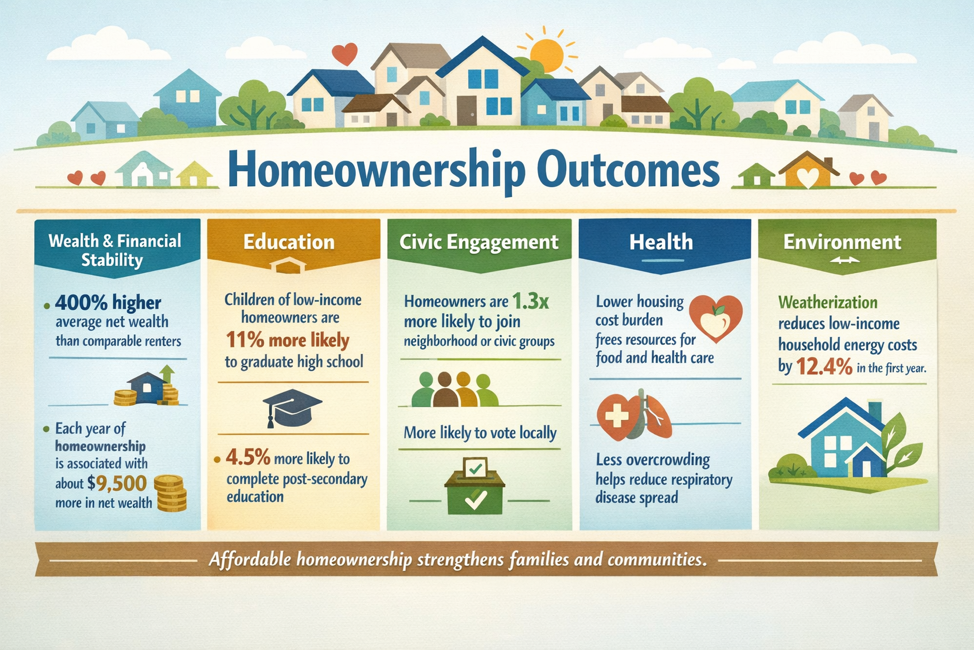
How homeownership changes children’s lives

First, homeownership creates stability. Children do better when they are not repeatedly uprooted by rent increases, unsafe housing conditions, or forced moves. Stable housing helps children remain in the same schools, sustain friendships, participate in activities, and build trusting relationships with teachers and neighbors. That continuity matters because educational progress and healthy development are closely linked to consistency in daily life.

Second, research shows that children in homeowner households often perform better academically. A widely cited study from the Harvard Joint Center for Housing Studies found that, after controlling for many economic and demographic factors, children of homeowners achieved math scores up to 9% higher and reading scores up to 7% higher than children of renters, while also showing modest reductions in behavioral problems. Habitat for Humanity’s research summary also reports that children of low-income homeowners are 11% more likely to graduate from high school and 4.5% more likely to complete postsecondary education than children of low-income renters. These findings suggest that homeownership is not only a housing outcome; it is also an education and opportunity outcome.

Third, homeownership can improve family health and well-being. Owning a decent, affordable home often means fewer housing hazards, less overcrowding, and more control over the home environment. Children in healthier housing are less likely to miss school because of respiratory illness, environmental triggers, or instability-related stress. Parents also benefit from greater predictability in housing costs and living conditions, which can reduce financial strain and support healthier routines for the entire family.

Most importantly, homeownership can drive generational change. For many families, a home is the largest asset they will ever own. Research highlighted by Habitat for Humanity indicates that U.S. homeowners have average net wealth roughly 400% higher than renters with similar demographics and earnings, and that each additional year of homeownership is associated with an average increase of about $9,500 in net wealth. That accumulated equity can help families weather emergencies, finance college, support entrepreneurship, or pass resources to the next generation. For lower- and moderate-income households, even a $10,000 increase in housing wealth has been associated with a 14% increase in the probability of college attendance. In this way, homeownership can transform a family’s trajectory, not just for one generation, but for the next.
The case for homeownership is therefore about more than owning property. It is about creating the conditions in which children can thrive: stability, safety, educational opportunity, and a tangible financial foothold. When families can access affordable, sustainable homeownership, they gain more than a place to live—they gain a platform for stronger children, more resilient families, and lasting generational progress.